
Robotic-Assisted Shoulder Replacement in 2027: What’s Changing
Robotic-arm assistance is one of the most notable recent developments in shoulder replacement. From October 2026, Dr Oscar Brumby-Rendell performs Mako robotic-assisted shoulder replacement at Eastwood Private Hospital.
This article explains how robotic assistance works, how it is expected to develop, and how it fits with 3D planning, navigation and less invasive surgery.

Robotic-Assisted Shoulder Replacement
Robotic-arm assistance has been used in hip and knee replacement for many years and has recently become available for shoulder replacement.
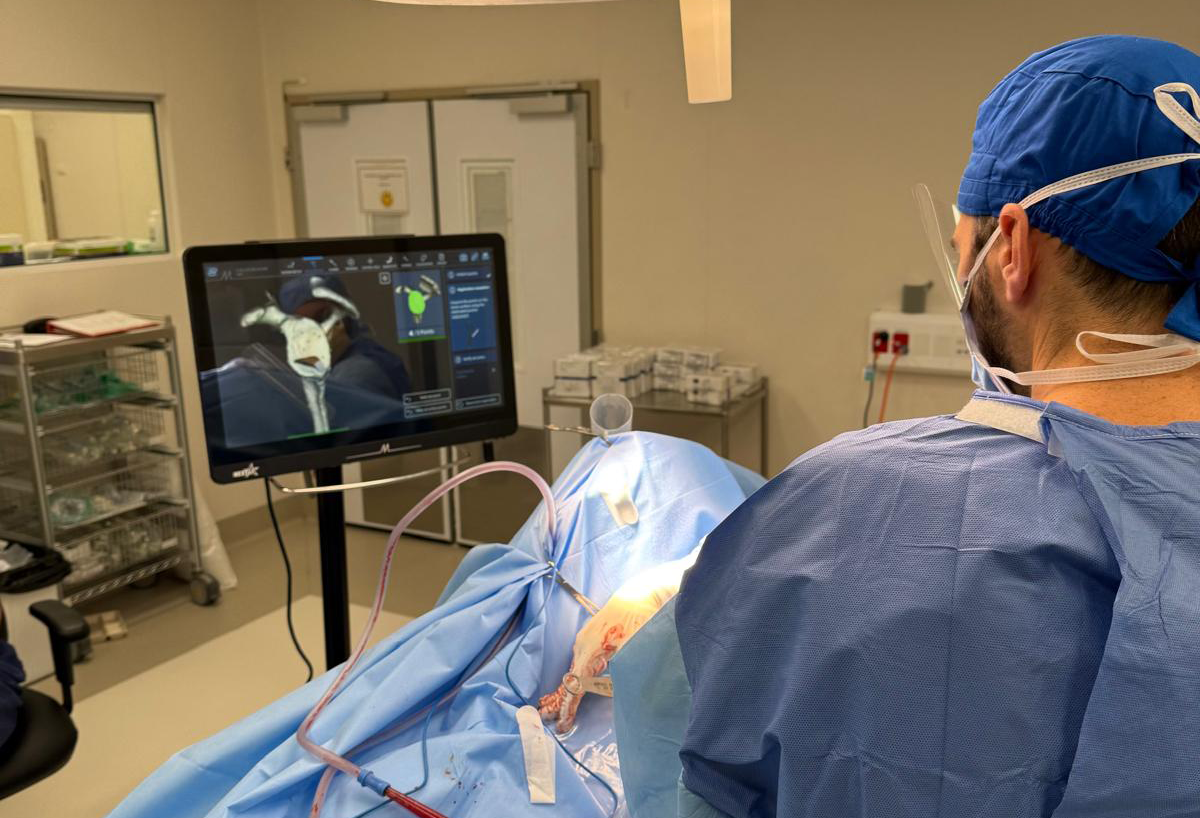
Each operation is planned in advance from a CT scan. During surgery, the robotic arm guides preparation of the bone within boundaries set by that plan, helping the surgeon reproduce the planned implant position. The surgeon performs the operation throughout; the robot does not operate independently. Dr Brumby-Rendell uses the Mako system for reverse shoulder replacement at Eastwood Private Hospital.
How accurate is it?
In a 2025 laboratory study, six shoulder surgeons prepared the socket (glenoid) on 36 bone models using standard instruments, patient-specific guides or a Mako robotic arm. Each result was then measured against the surgical plan. Robotic preparation came closest to the plan on most measures.

This study used bone models, not patients. Clinical studies on whether greater accuracy leads to better long-term results for patients are still underway, and not every patient will be suitable for a robotic-assisted procedure.

How Robotic Assistance Will Develop
Robotic assistance in shoulder replacement is being introduced in stages:
- Now: the robotic arm assists with preparation of the glenoid (socket), one of the most technically demanding steps of the operation.
- Next: assistance is expected to extend to preparation of the humerus (upper arm bone).
- Then: range-of-motion mapping, to help assess how the new shoulder moves during surgery.
As each stage becomes available, Dr Brumby-Rendell will incorporate it where it is appropriate for the individual patient.
Built on 3D Planning and Navigation
Every robotic-assisted operation starts with a 3D plan. A CT scan is used to build a model of the shoulder blade and upper arm bone, so the surgeon can assess deformity and bone loss and choose the implant size and position before surgery. Studies show that 3D planning improves the accuracy of implant positioning.
Navigation links the patient's anatomy to that plan during surgery and shows instrument position on a screen in real time. Pooled studies show it improves the accuracy of socket (glenoid) component placement, although it can add some time to the operation.
Dr Brumby-Rendell uses 3D CT planning and navigation routinely.
Less Invasive Approaches
Where appropriate, Dr Brumby-Rendell performs shoulder replacement through a smaller incision of around 5 cm, compared with around 10–15 cm traditionally. The aim is less disruption to the surrounding muscles and tendons. Research on muscle-sparing approaches shows outcomes comparable to standard approaches. A standard incision may still be the safer option where there is significant deformity, bone loss or previous surgery.
Learn more about minimally invasive shoulder joint replacement.
Beyond Robotics
Other areas of active research include augmented-reality displays in theatre, artificial intelligence to support planning and predict recovery, and further development of implant designs and materials. Most of these remain at an early stage.
What This Means for You
These technologies are tools to help the surgeon place the implant accurately. They don't remove the risks of shoulder replacement, which include infection, stiffness, nerve injury, instability and implant loosening, and results vary between individuals.
The right approach for you will be discussed at your consultation, based on your imaging and circumstances.
