
Pectoralis
Major Rupture
Shoulder
Condition
A pectoralis major rupture is more than just a "pulled muscle." It involves a significant tear of the tendon where it attaches to the upper arm (humerus). Because this injury can lead to a permanent loss of strength and a visible change in the contour of the chest, an accurate diagnosis and early specialist intervention are essential.

What Causes Pectoralis Major Rupture ?
A pectoralis major rupture is a relatively rare but significant injury, most commonly occurring in men aged 20 to 50. It typically happens during high-intensity activities that place the chest muscle under extreme tension while it is stretched; most notably during a bench press or a tackle in rugby.
When to Seek Aid for your Condition?
You should consult us if you experience the following:
-
The "Pop": A sudden tearing sensation or audible snap in the chest or upper arm during heavy lifting.
-
Visible Deformity: A "hollowing" of the armpit area or a bulging of the chest muscle toward the center of the body.
-
Extensive Bruising: Significant bruising (ecchymosis) that often travels down the inner bicep and across the chest wall.
-
Weakness: Inability to push objects away from your body or bring your arm across your chest.

Treatment Options
The choice of treatment depends heavily on the location of the tear (tendon-to-bone vs. muscle-to-tendon), the degree of the rupture, and your lifestyle goals.
Non-Operative Treatment
Conservative management is usually reserved for partial tears or for patients with lower physical demands who do not require full strength for sports or heavy manual labor.
-
Sling Immobilization: Used for 3–4 weeks to allow the tissue to scar and stabilize.
-
Activity Modification: Avoiding heavy pushing or pulling movements during the healing phase.
-
Physiotherapy: Focusing on restoring range of motion once the initial pain subsides.
-
Outcome: While pain usually resolves, there is often a persistent cosmetic deformity and a 20% to 50% loss of peak pushing strength.
Operative Treatment
Surgery is the "gold standard" for complete tendon ruptures in active individuals. The goal is to reattach the torn tendon back to its anatomical footprint on the humerus (upper arm bone).
-
The Procedure: Small incisions are made, and the tendon is secured back to the bone using high-strength sutures and anchors or bone buttons.
-
Benefits: Restores the natural contour of the chest and significantly increases the likelihood of returning to pre-injury strength levels.
-
Timing: Surgery is most successful when performed within 3 to 6 weeks of the injury. Chronic repairs (months later) are possible but often require more complex reconstruction.
Recovery and Rehabilitation

Recovery from a pectoralis major repair is a staged process designed to protect the repair while gradually restoring function.
-
Phase 1: Protection (0–6 Weeks) The arm is kept in a sling. Gentle pendulum exercises and passive range of motion are started under the guidance of a physiotherapist, but no active chest contraction is allowed.
-
Phase 2: Restoration of Motion (6–12 Weeks) The sling is removed. You will begin active movements to regain full flexibility. Light resistance band work may start toward the end of this phase.
-
Phase 3: Strengthening (3–6 Months) Progressive resistance training begins. You will start with very light weights, focusing on high repetitions and perfect form.
-
Phase 4: Return to Sport (6+ Months) Full return to heavy bench pressing or contact sports usually occurs between 6 and 9 months, once strength symmetry is achieved.
Frequently Asked Questions
Common questions and answers about shoulder arthroscopy
It is often most comfortable to sleep in a semi-upright position (using a recliner or several pillows) with a small pillow tucked behind your elbow to prevent the arm from falling backward and stretching the repair.
Why Choose Dr Oscar Brumby-Rendell?
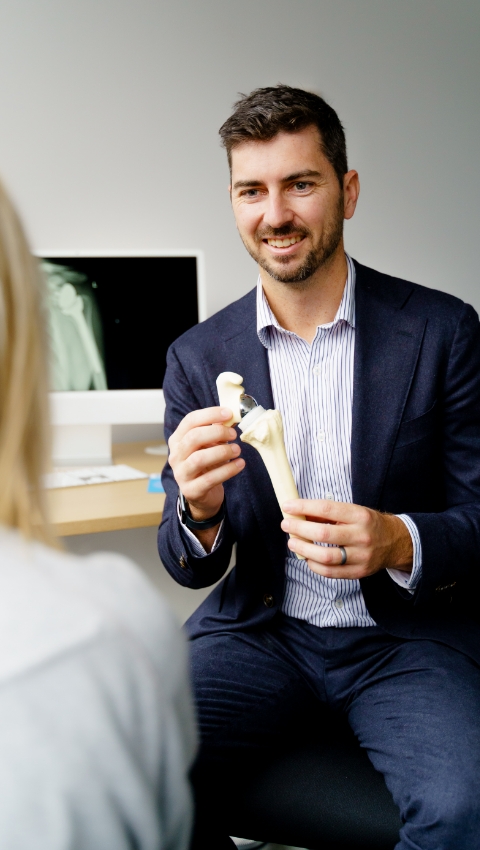
Dr Oscar has undergone rigorous training both locally and internationally, including a distinguished fellowship with the International Bone Research Association and specialised microsurgical training. He emphasises personalised care, ensuring that each patient receives tailored treatment designed to meet their unique needs and preferences. Dr Oscar is dedicated to achieving the best possible surgical outcomes for his patients.
Ready to learn more?
Watch our videos of other shoulder-relarted injuries by Dr Oscar Brumby-Rendell.
Read more about shoulder-related injury treatments Dr. Brumby-Rendell offers here: